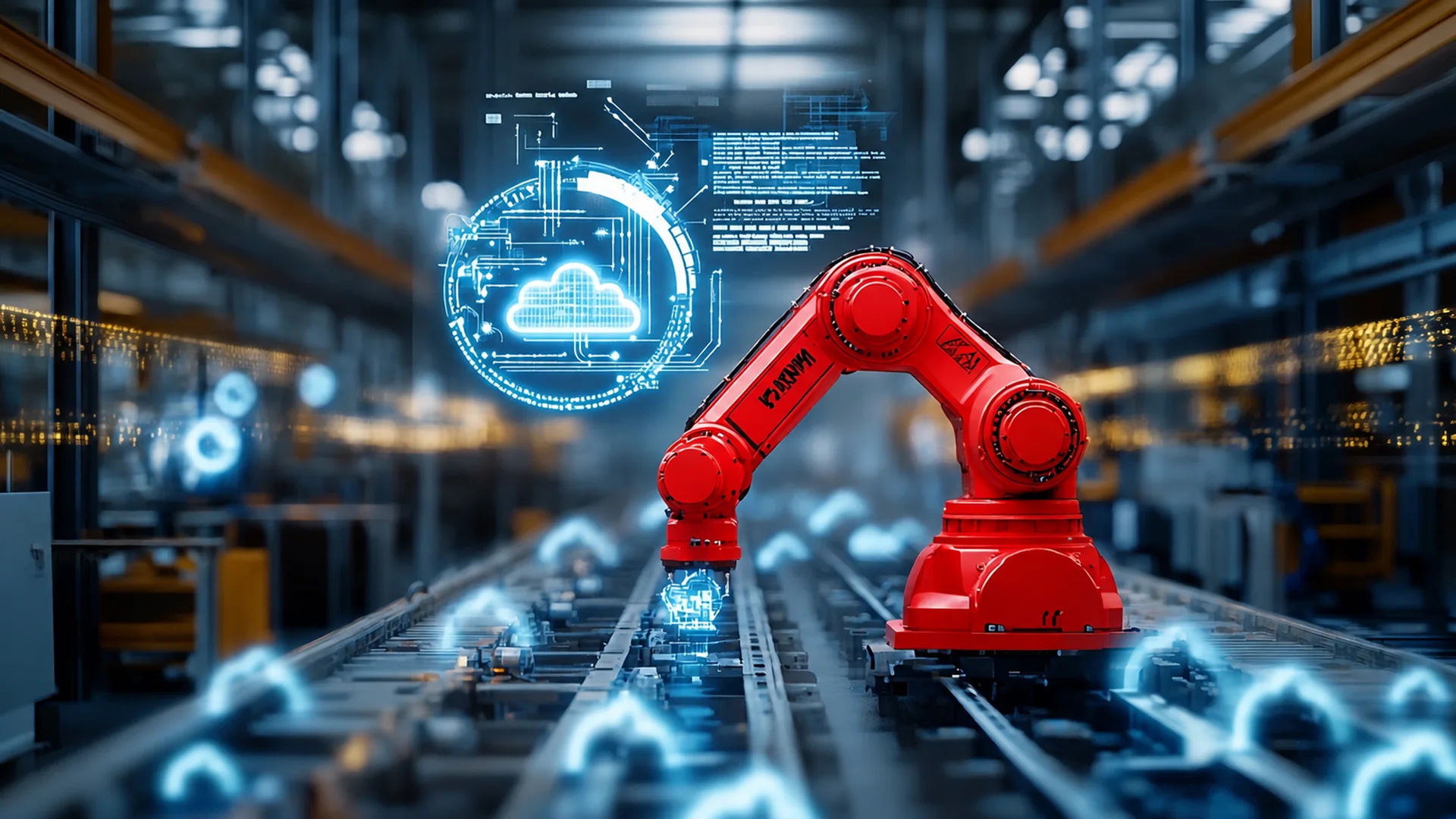
In 2026, edge AI and hybrid cloud architectures have become indispensable for manufacturing, enabling sub-millisecond inference in latency-sensitive operations like factory automation and EV assembly. By shifting AI workloads to the edge, companies achieve real-time decision-making without cloud delays, while hybrid clouds handle scalability and heavy analytics. Ferfier Technologies leads with cloud-native stacks that deliver compliant, seamless deployments for OEMs pushing Industry 4.0 boundaries.
Why Edge AI is Critical for Latency-Sensitive Manufacturing
Traditional cloud AI introduces 200-500ms latencies-unacceptable for robotics or quality control where milliseconds mean defects or downtime. Edge AI processes data on-device or local gateways, running inference directly on sensors and machines for instant actions like halting a faulty weld or adjusting conveyor speeds.
In factories, this powers predictive maintenance: vibration sensors on presses trigger AI models to flag wear before failure, cutting unplanned stops by 40%. For EVs and SDVs, edge AI in test bays simulates battery stress tests in real time, accelerating validation cycles. With global edge AI markets hitting $118B by 2033 at 21.7% CAGR, 2026 marks the tipping point for widespread adoption in smart factories.
Hybrid Cloud: Balancing Edge Power with Scalability
Pure edge lacks storage and compute for model training or cross-site analytics-enter hybrid cloud. Edge handles urgent ops (e.g., robot pathing), offloading non-urgent tasks like anomaly trend analysis to the cloud. This architecture ensures resilience: if an edge node fails, cloud failover maintains ops.
Benefits include 20% lower maintenance via automated model updates and secure data lakes for IP protection. In 2026, hybrid setups comply with evolving regs like US NIST frameworks, blending on-prem sovereignty with AWS/Azure elasticity. Ferfier’s cloud-native stacks shine here, offering Kubernetes-orchestrated deployments that auto-scale inference across edge-cloud boundaries for mission-critical manufacturing.
Real-World Example: Robotics in SDV Production
Boston Dynamics’ agile robots exemplify edge AI in action, now partnering with Hyundai Mobis for SDV mass production. Spot and Atlas variants, equipped with edge neural processing units (NPUs), navigate dynamic assembly lines-fetching parts, inspecting welds, and collaborating with humans. Edge inference enables <50ms obstacle avoidance, boosting throughput by 30% without cloud dependency.
In EV factories, these robots use hybrid clouds for fleet coordination: local edge decides paths, cloud optimizes global scheduling. Qualcomm’s SoCs power the actuators, integrating seamlessly for SDV controllers. Such setups cut production costs 25%, vital as SDV volumes surge under 2026 incentives. Ferfier enables this via IoT-AI gateways that fuse robot telemetry with factory MES, ensuring compliant, scalable ops for OEMs like Hyundai.
Ferfier’s Cloud-Native Stacks: OEM Deployment Accelerators
Ferfier Technologies differentiates with purpose-built stacks for edge-hybrid manufacturing. Their containerized platforms support zero-touch provisioning: deploy AI models to thousands of edge devices via Helm charts, with built-in compliance for GDPR/CCPA. Key features include dynamic load balancing-edge for latency, cloud for training-and NPU optimization for 10-20x power efficiency over GPUs.
OEMs praise Ferfier’s dashboards for visualizing inference pipelines, from robot vision to EV quality gates. In a recent pilot, Ferfier cut deployment time 60% for a Tier-1 supplier, enabling real-time anomaly detection across 500 robots.
Overcoming Challenges in 2026 Deployments
Security looms large-edge exposes more attack surfaces-but hybrid models with zero-trust enclaves mitigate risks. Interoperability across legacy PLCs and new SDV stacks requires middleware; Ferfier’s APIs bridge this effortlessly. Skill gaps? Their low-code tools empower engineers, not just PhDs.
Sustainability gains shine too: edge reduces data transit energy by 70%, aligning with net-zero factories. As Trump-era policies boost domestic chip production, Ferfier’s US-based stacks gain edge in supply chain resilience.
Future Outlook: Autonomous Factories Unleashed
By late 2026, expect 70% of factories hybridizing, with edge AI dominating robotics and vision tasks. Ferfier envisions swarms of Boston Dynamics-like bots in fully autonomous lines, trained via hybrid loops. For manufacturers, this duo isn’t optional-it’s the unlock for competitive survival.
In manufacturing, the value of real-time data lies in how quickly teams can act on it. If you’re looking at where edge AI and hybrid cloud could make a practical difference, talk to us.